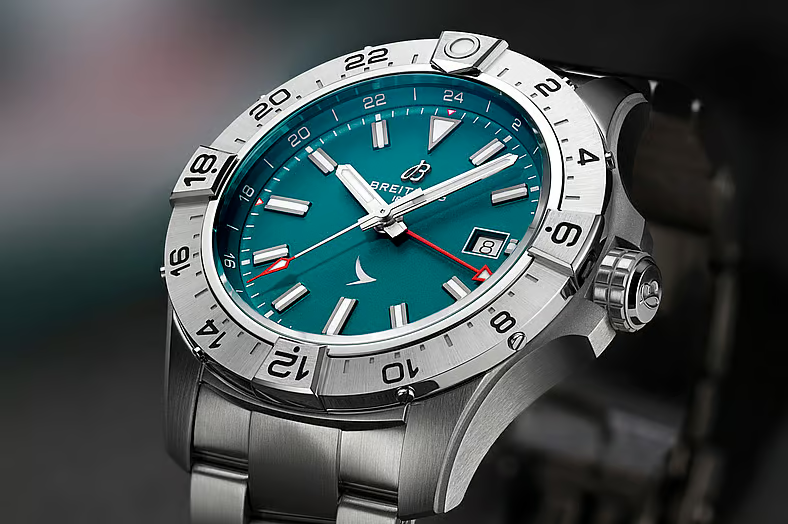
Breitling Avenger Automatic GMT 44 Cathay Pacific 80th Anniversary Edition: Three Time Zones, One Aviation Story

An airline and a watchmaker collaborating on a GMT watch is an obvious pairing. Making the result feel relevant beyond a logo on the dial is considerably more difficult.
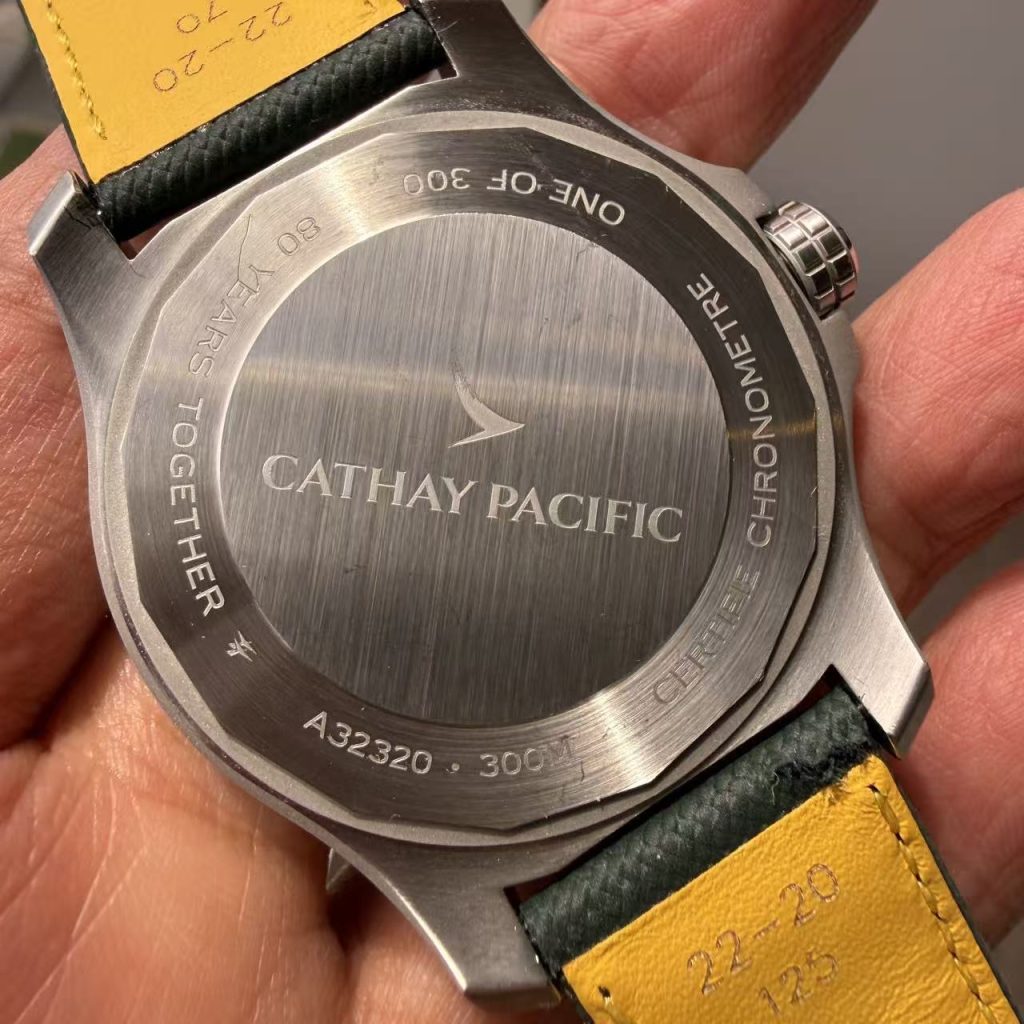
The Breitling Avenger Automatic GMT 44 Cathay Pacific 80th Anniversary Edition arrives in 2026 to mark eight decades of Cathay Pacific. Limited to 300 pieces and available exclusively through Cathay Shop, the watch takes the Avenger Automatic GMT 44 and gives it a distinctly Cathay identity through its Cathay Jade green dial and Brushwing emblem.
There is also a deeper connection here. Cathay Pacific was founded in 1946 by former wartime pilots Roy Farrell and Sydney de Kantzow, beginning with a Douglas DC-3 known as “Betsy.” Eighty years later, aviation remains inseparable from the company’s identity.
Breitling’s relationship with aviation goes back even further. In the late 1930s, the company established its Huit Aviation department to develop cockpit instruments for military and civil aviation. By 1939, Breitling was supplying onboard chronographs to Britain’s Royal Air Force, subjecting those instruments to temperature and vibration testing because reliability in an aircraft was a functional requirement rather than a marketing concept — which makes the Avenger GMT a particularly appropriate platform for this anniversary.

What Made an Aviation Watch Different?
It is easy today to regard a pilot’s watch simply as a design category: large case, bold numerals, luminous hands and perhaps a GMT or chronograph complication. Historically, however, the requirements came from some very practical problems.
Aviation demanded legibility. A pilot or navigator had to obtain information quickly and unambiguously, sometimes in poor light and while simultaneously managing an aircraft. Breitling’s own 1953 Co-Pilot, for example, placed particular emphasis on large luminous numerals and an easily readable dial. Its Navitimer went in another direction, providing pilots with a circular slide rule for calculations involving speed, distance, fuel consumption and rate of climb.
Then there was robustness. Aircraft brought vibration, large changes in temperature and the simple possibility of knocking a watch against equipment in a confined cockpit. Breitling’s Huit Aviation department was already testing instruments using temperature simulators and vibration tables in the 1930s.
And there was magnetism. As cockpits became increasingly filled with electrical equipment and instruments, magnetic fields presented another problem for mechanical watches, interfering with the regulating organ of a movement and its ability to keep accurate time. This is why antimagnetic construction became an important consideration in certain military and aviation watches, sometimes through the use of a soft-iron inner case to shield the movement.
That history matters because it explains why clarity, durability, secure cases and easily operated controls recur again and again in aviation watches. The modern Avenger is not pretending that a mechanical wristwatch is still an essential flight instrument in an age of digital avionics, but its architecture follows much of the same logic.
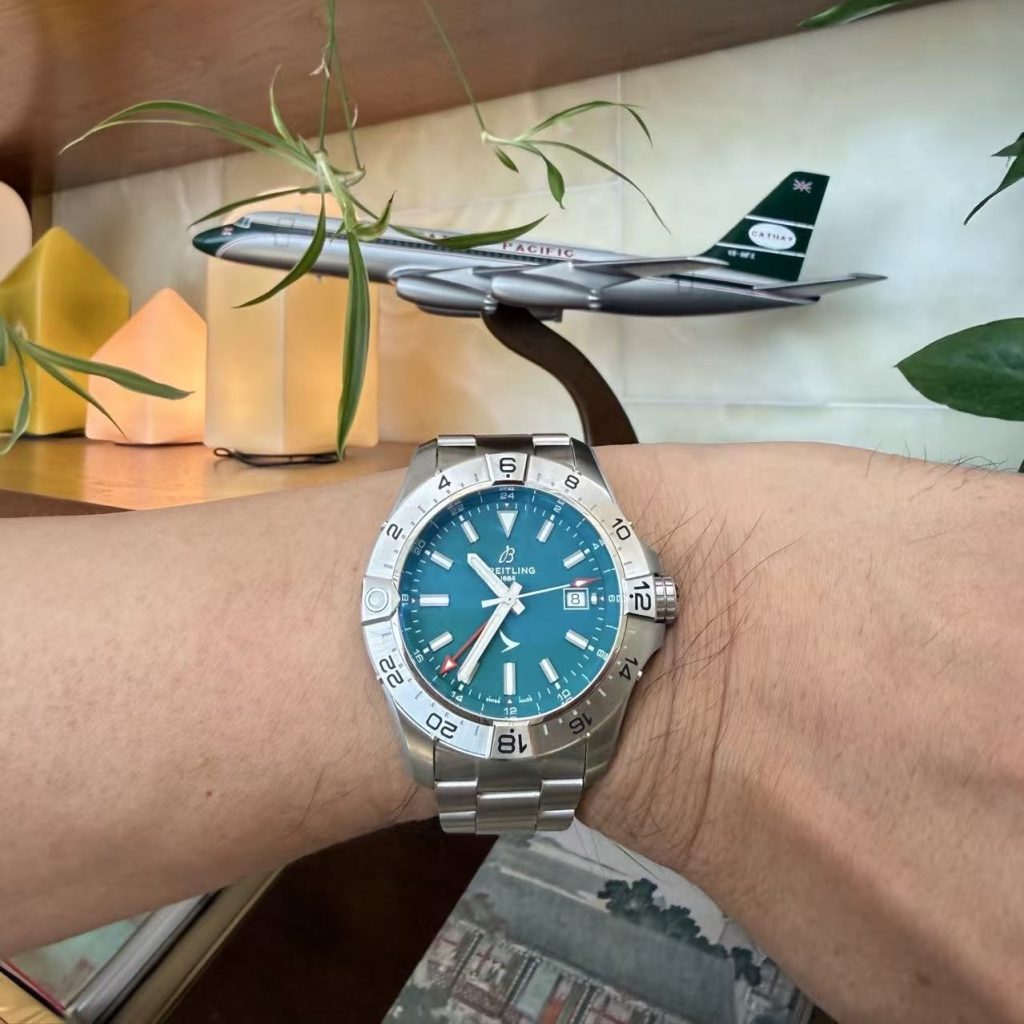
The Avenger Formula
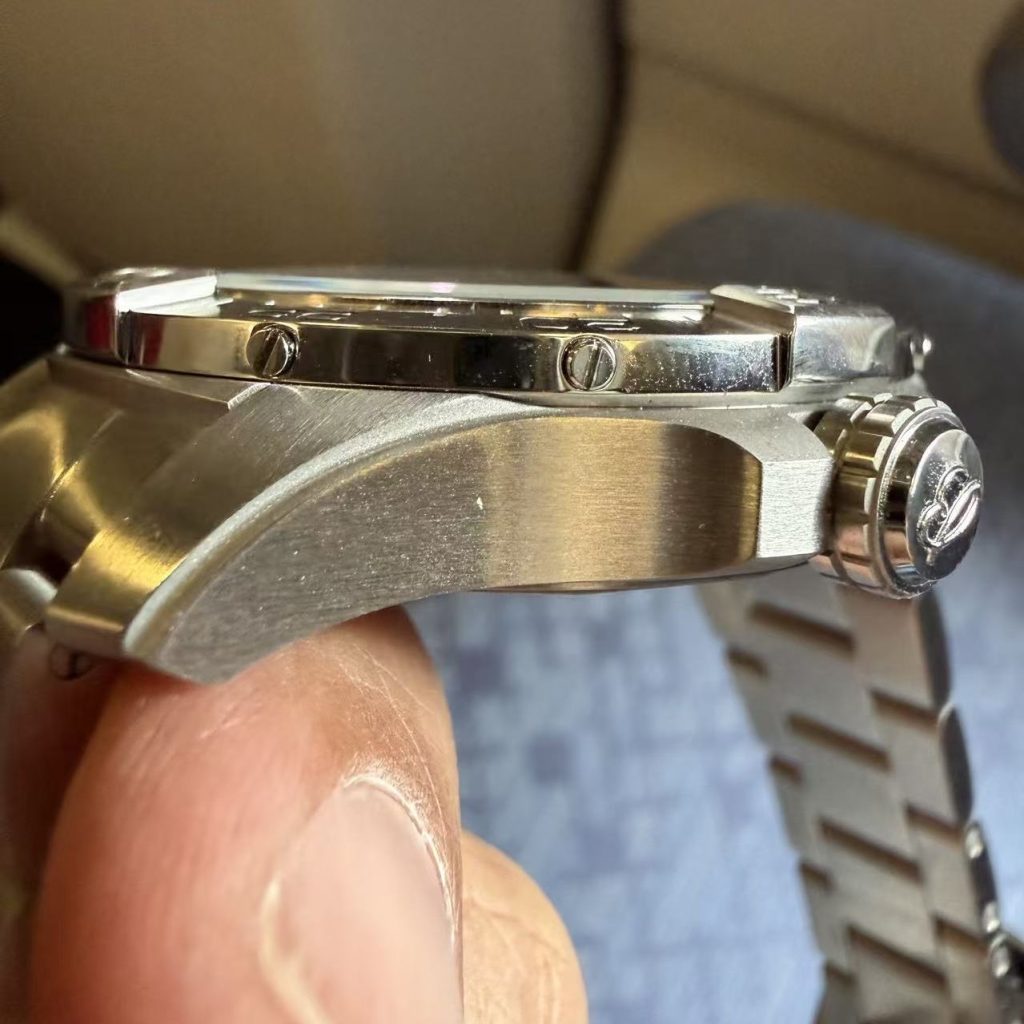
The Cathay Pacific edition measures 44mm in diameter and 12.05mm thick, with a stainless-steel case, cambered sapphire crystal with anti-reflective treatment on both sides and water resistance to 300 metres. That last figure may sound excessive for a pilot’s watch, but it contributes to the Avenger’s character as a genuine all-purpose tool watch.
The screw-down crown is another detail worth discussing. A crown is naturally one of the openings through which water can potentially enter a watch case, and screwing it securely against the case provides additional protection to the sealing system while making it considerably less likely that the crown will accidentally be pulled out while the watch is being worn. For something conceived as a robust travel watch, that additional protection makes sense.
At 44mm, this is unquestionably a large watch, but 12.05mm is relatively restrained considering the diameter, automatic GMT movement and 300-metre water resistance. The proportions prevent it from becoming the sort of oversized, excessively thick tool watch that looks impressive on paper but becomes tiring on the wrist.
The stainless-steel bracelet further improves the usability. Its solid folding clasp incorporates a useful extension and fine incremental adjustment, allowing the bracelet to be altered in small steps without removing links — enough adjustment, in fact, to accommodate the expansion of your wrist in warmer weather. It is a small detail, but one that becomes considerably more important once you actually wear the watch for an entire day, and the mechanism feels reassuringly solid. This is the sort of feature that rarely dominates a specification sheet but contributes greatly to whether a watch becomes something you actually travel with.
Cathay Jade
The most immediate visual difference is obviously the dial. Cathay Jade green is a particularly effective choice because it identifies the watch with Cathay without requiring the entire design to be covered in airline branding — the Brushwing logo appears on the dial, but the overall appearance remains unmistakably that of an Avenger, and that distinction matters. Airline watches can very easily become memorabilia first and watches second; here, the anniversary identity is clear enough for somebody familiar with Cathay to recognise it immediately, yet subtle enough that the watch can stand independently.
Applied hour markers and broad hands receive luminous treatment, and the contrast between them and the green dial keeps the fundamental pilot-watch requirement of quick legibility intact. A date aperture sits at 3 o’clock.
Then there is the feature that makes this watch considerably more interesting than a conventional anniversary edition: the GMT system.

Understanding the GMT Display
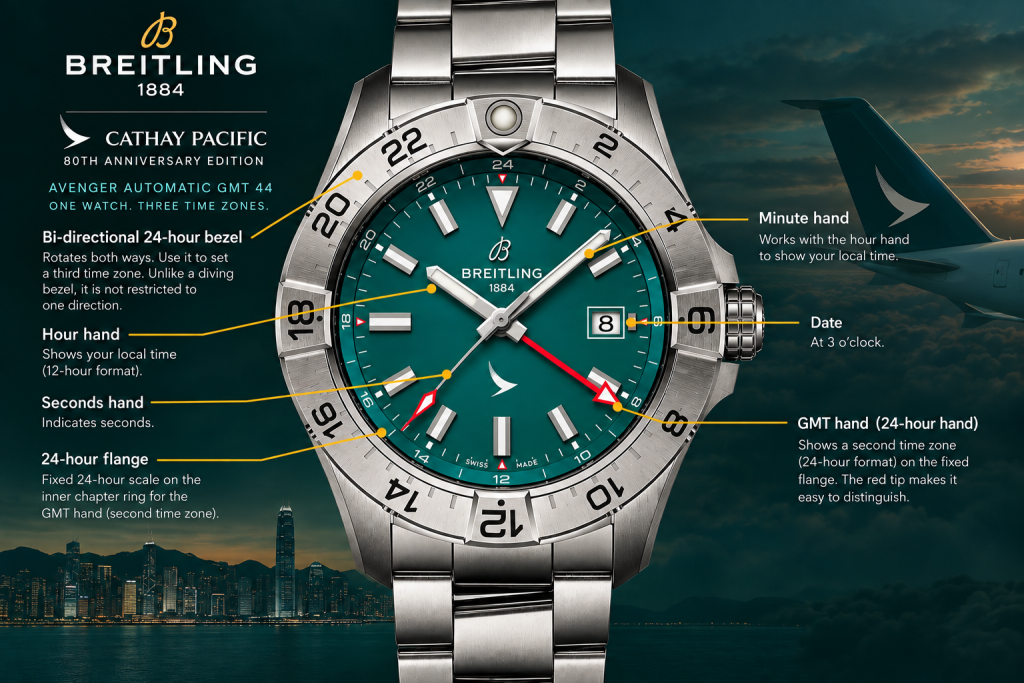
Inside is the automatic Breitling calibre 32, and the key to understanding the watch is its additional 24-hour GMT hand. The normal hour hand travels around the dial once every 12 hours; the GMT hand takes 24 hours to make one complete revolution — a distinction that matters more than it might first appear.
If the normal hour hand points at 8, you need outside knowledge to know whether it is 8am or 8pm. The GMT hand, however, is read against a 24-hour scale on the flange surrounding the dial. If it indicates 20, there is no ambiguity: it is 20:00, or 8pm.
For most owners, the simplest arrangement is therefore to use the normal hour and minute hands for local time and the GMT hand against the fixed 24-hour flange for a second time zone — already useful on its own, but the Avenger has one more trick up its sleeve.
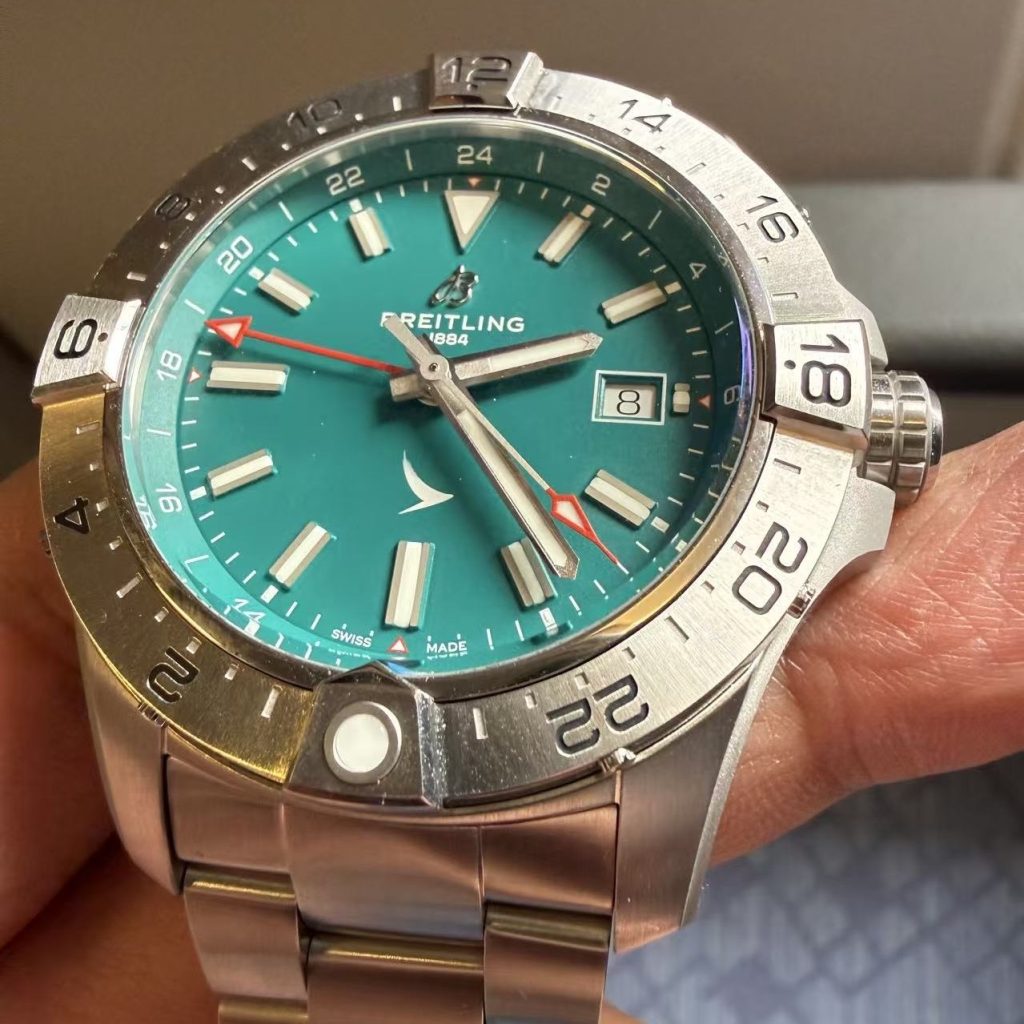
How to Read Three Time Zones
The external bezel also carries a 24-hour scale, and unlike the bezel of a conventional diving watch, it rotates in both directions. That means the same GMT hand can simultaneously be read against two different 24-hour scales — the fixed scale on the flange and the offset scale on the rotating bezel — and the result is a third time zone.
It is simpler in practice than it sounds described, so here is a working example. Imagine you are in Hong Kong and regularly need to monitor London and New York. For the sake of the example, let us say it is 10:00 in Hong Kong, 03:00 in London and 22:00 on the previous day in New York.
First, set the conventional hour and minute hands to 10:00. These are now showing your local Hong Kong time.
Next, set the GMT hand so that it points to 03 on the fixed 24-hour flange. The GMT hand is now displaying London time.
At this stage you already have:
Hong Kong — 10:00, shown by the conventional hands.
London — 03:00, shown by the GMT hand against the fixed 24-hour flange.
Now we want New York. Without changing the GMT hand, rotate the external 24-hour bezel until 22 on the bezel sits at the position currently occupied by the GMT hand.
You can now read the same GMT hand against two scales:
Read it against the fixed flange and it says 03:00 — London.
Read it against the rotating bezel and it says 22:00 — New York.
Meanwhile, the conventional hands still say 10:00 — Hong Kong.
One watch. Three time zones.
More importantly, once you have positioned the bezel for the difference between your second and third zones, you do not need to keep doing mental arithmetic — as the GMT hand progresses around the dial, both readings progress with it. That is the clever part of the system.
There is one practical consideration to remember when using any GMT watch this way: daylight-saving changes can alter the time difference between cities during the year. If London or New York changes its clocks, for example, you need to adjust the relevant GMT indication or bezel offset accordingly.

Why the Bezel Is Bidirectional
The fact that the Avenger’s 24-hour bezel can rotate clockwise or counterclockwise is important, because this is not a diving bezel. A conventional diving bezel normally rotates in only one direction for safety: a diver aligns the bezel with the minute hand to measure elapsed dive time, and if it is accidentally knocked underwater, the unidirectional mechanism means it can only move in the direction that indicates more time has elapsed. It cannot accidentally suggest that the diver has more remaining dive time than is actually the case.
A GMT bezel has a completely different job. Here, there is no safety benefit to restricting movement to one direction — you may need to offset the scale several hours clockwise for one city and several hours counterclockwise for another, and a bidirectional bezel lets you reach the required position by the shortest route, which is both faster and more logical for a multi-time-zone watch.
It also explains why the bezel should not simply be viewed as a decorative part of the Avenger’s design. Together with the GMT hand and fixed 24-hour flange, it forms part of the actual time-zone system.
Caller GMT Versus Flyer GMT
There is another distinction worth understanding if you are serious about GMT watches. The Breitling calibre 32 allows the 24-hour GMT hand to be adjusted independently — in watch-collector terminology, this type of arrangement is often referred to as a “caller GMT.” The alternative architecture is commonly called a “flyer GMT,” where the conventional local hour hand can usually be jumped forward or backward in one-hour increments without disturbing the home-time indication.
Which is better depends on how you use the watch. If you are constantly stepping off aircraft and changing your local time, an independently adjustable local hour hand is extremely convenient: you land, jump the local hand forward or backward by the appropriate number of hours, and leave your home-time GMT indication untouched. A caller GMT approaches the problem differently — you leave your normal time display alone and independently move the GMT hand to whichever overseas time zone you want to monitor.
That can actually be very intuitive if you spend much of your time in one location but routinely communicate with people elsewhere — for example, somebody based in Hong Kong who regularly deals with London and New York. And because the Avenger adds the rotating 24-hour bezel, that one GMT hand can monitor two overseas locations simultaneously. So although calibre 32 is mechanically quite straightforward, the complete display is more useful than its simple appearance initially suggests.
The Cathay Connection
This is the second Cathay Pacific and Breitling collaboration in recent years, following the 200-piece Navitimer B01 Cathay Pacific Limited Edition in 2022. The choice of an Avenger GMT this time changes the personality considerably.
The Navitimer is perhaps Breitling’s most historically recognisable aviation watch, rooted in the era when pilots could use its circular slide rule to perform flight-related calculations. The Avenger is a more contemporary interpretation of the pilot’s watch: straightforward, robust and built around immediate usability.
For an 80th-anniversary piece, that makes sense — the watch acknowledges aviation history without attempting to recreate 1946. And unlike an anniversary inscription that may have significance only to the company commissioning it, the GMT complication relates directly to what an international airline actually does: connect one place and one time zone with another.
At first glance, the attraction of the Breitling Avenger Automatic GMT 44 Cathay Pacific 80th Anniversary Edition is obvious. The Cathay Jade dial looks good, the Brushwing gives the watch a recognisable identity, and a production run of 300 pieces makes it genuinely limited.
But I think the functionality is what makes the collaboration work: the GMT hand gives you a second time zone, the fixed flange makes that reading unambiguous, and turning the bidirectional bezel to the right offset gives the same hand a third. For somebody who travels frequently, works internationally or simply has family and colleagues distributed around the world, that is genuinely useful.
I also appreciate the less glamorous details. The 300-metre water resistance, screw-down crown, easily manipulated bezel and very good incremental bracelet adjustment mean this feels like a watch intended to be worn rather than kept as airline memorabilia.
And then there is the anniversary itself: Cathay Pacific turning 80 is a significant milestone for an airline whose history is so closely tied to Hong Kong. Combine that with a 300-piece production run, a recognisable Cathay-specific colour and a complication that genuinely relates to international travel, and it stops feeling like a routine anniversary release.
The Breitling Avenger Automatic GMT 44 Cathay Pacific 80th Anniversary Edition is priced at HKD49,800, and Cathay members can also redeem it entirely with 881,380 miles through Cathay Shop. For those sitting on a substantial Asia Miles balance, that last option adds an unusual final dimension: you can quite literally turn the miles accumulated through travel into a mechanical watch designed to keep track of where in the world everyone is.